
News Center
Precautions for Anti-static and Grounding Design in Electronic Cleanrooms
2025/12/2
Cleanrooms should be equipped with anti-static environments in accordance with the requirements of the production process. The design of anti-static environments should meet the requirements of suppressing or reducing the generation of static electricity, as well as quickly, safely and effectively discharging the static electricity that has already been generated.
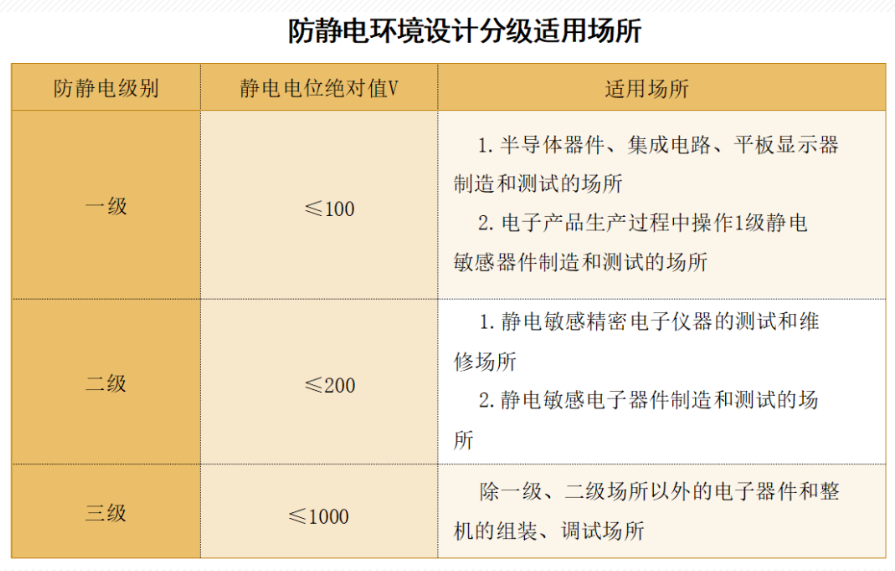
Anti-static environment design should be classified according to electronic products or production processes (equipment). The absolute value of the electrostatic potential in the anti-static environment should be less than the safe electrostatic potential value of the electronic product. The design of anti-static environments should be divided into three levels. The applicable places for each level of anti-static environment design should comply with the requirements of the following table.
2、Anti-static Measures
In the anti-static environment of clean workshops, the surface layer structure and materials of the anti-static floor should meet the following requirements:
The selection of the anti-static floor surface layer should meet the requirements of the electronic product production process.
2. The surface layer of the anti-static floor should be made of electrostatic dissipative materials, and the surface resistivity of the electrostatic dissipative materials should be 2.5×10^4 to 1×10^9Ω.
3. Anti-static floors should be equipped with static discharge facilities and grounding connections. The resistance value of the ground to the ground discharge should be 1×10^5 to 1×10^8Ω.
The decoration design of the ceiling, walls and columns in the anti-static environment of clean workshops shall comply with the following requirements:
The floor, walls and columns in the first-level anti-static work area should be of the electrostatic conductive type. The surface resistance and ground resistance of electrostatic conductive floors, walls and columns should be 2.5×10^4 to 1×10^6Ω. The frictional starting voltage should not exceed 100V, and the electrostatic half-life should not be greater than 0.seconds.
2. The floor, walls, columns, ceiling, doors and soft curtains in the secondary anti-static work area should be of electrostatic dissipation type. The surface resistance and ground resistance of electrostatic dissipation type floors, walls, columns, ceilings and doors should be 1×10^6 to 1×10^9Ω. The frictional starting voltage should not exceed 200V, and the electrostatic half-life should not exceed 1 second. However, the frictional starting voltage of soft curtains should not exceed 300V.
3. The floor, walls and columns of the third-level anti-static work area should be made of electrostatic dissipative materials or low start materials according to the production process requirements, and the ceiling, doors, etc. should be made of low start materials. The frictional starting voltage of floors, walls, columns, ceilings, doors and other surfaces made of low starting materials should not exceed 1000V.
The design of doors and Windows for anti-static environments in clean workshops shall comply with the following requirements:
1. Electrostatic dissipative materials should be selected for making doors and Windows or dissipative materials should be used for veneering.
2. The surface of metal doors and Windows should be coated with electrostatic dissipative coatings and grounded.
When large areas of glass are installed on indoor partitions and observation Windows, the surface of the glass should be adhered with electrostatic dissipative transparent films or coated with electrostatic dissipative coatings.
The decoration design of the anti-static environment in clean workshops should comply with the following requirements:
All kinds of decoration materials should have surface electrostatic dissipation performance. High-molecular insulating decoration materials that have not undergone surface modification treatment shall not be used.
2. The finishes of all kinds of decoration should be smooth and flat.
3. The supply air outlets and air ducts of the purification air conditioning system in the anti-static environment of the clean workshop should be made of conductive materials and grounded.
4. When the purification air conditioning system and various piping systems in the anti-static environment of clean workshops use partially insulating materials, metal mesh should be installed on their surfaces and grounded. When using conductive rubber hoses, a metal conductor that is closely bonded to the hose should be installed on the hose, and a grounding lead should be used to reliably connect and ground it.
3、Anti-static Grounding
Discharging static electricity to the ground is a major method for eliminating static electricity. To ensure the rapid, safe and effective discharge of static electricity, all metal objects and static conductive materials in the clean area should be reliably grounded. Static electricity grounding should be provided for anti-static floors, raised floors, worktops, seats, etc.
The connection wire for static grounding should have sufficient mechanical strength and chemical stability. The cross-sectional area of the main line should not be less than 95mm², and the minimum cross-sectional area of the branch line should be 2.5mm².
Static electricity in contact with the human body should be grounded in series with a current-limiting resistor, and the resistance value of the current-limiting resistor is preferably 1 m Ω.
In the clean workshops of the electronics industry, there are various equipment and pipelines for the transportation and storage of flammable, toxic gases, liquids or powders. These media equipment and pipelines are also places where static electricity hazards are prone to occur. Therefore, reliable and safe grounding measures should be taken for the equipment and pipelines of these media to discharge static electricity to the ground, so as to ensure that once static electricity is generated, it can be discharged quickly, effectively and safely. Equipment and pipelines with explosion and fire hazards shall comply with the relevant provisions of the current national standard "Code for Design of Electrical Installations in Explosive and Fire Hazardous Environments" GB 50058.